
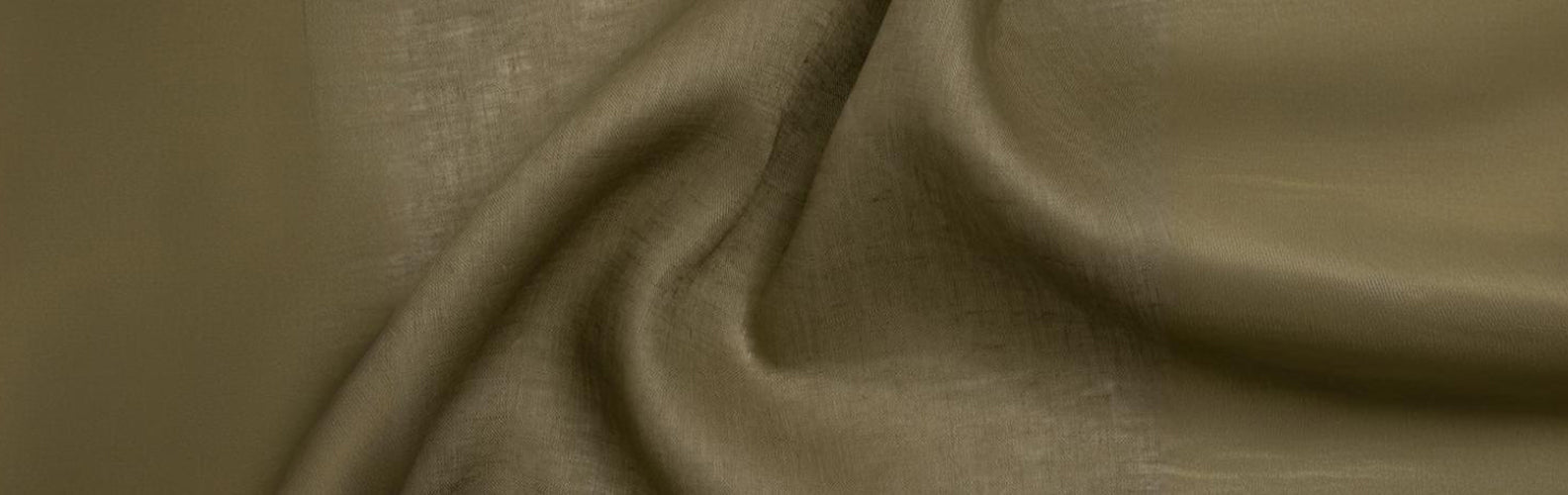
Before buying linen fabric, check fibre composition, GSM, weave, opacity, finishing, colour, shrinkage and care instructions.
These details decide how the cloth will feel, fall, crease, wash and age over time. They matter whether you are buying linen by the meter, choosing upholstery cloth, or selecting a ready-made linen garment.
All linen is not the same.
Some clothes are 100% linen. Some are blended with cotton, viscose, lyocell, modal or polyester. Some linen is light and fluid. Some are heavier and more structured. Some are made for shirts and dresses. Some belong better to trousers, jackets, curtains or upholstery.
The right linen begins with understanding the cloth.
1. Check the Fibre Composition
Start with the label.
Genuine linen is made from flax fibre. If the label says 100% linen, the cloth is pure linen. If it says linen-cotton, linen-viscose, linen-lyocell, linen-modal, linen-polyester or linen blend, the cloth has been mixed with another fibre.
A blend is not always wrong. It may feel smoother, cost less, crease less or fall differently on the body. But it will not behave exactly like pure linen.
Pure linen usually has more texture, more character and a more natural fall. It softens with wear and washing, and the garment becomes more personal over time.
At Yell, we work with 100% pure linen because the cloth carries the qualities we want our garments to hold: ease, structure, movement and long wear.
2. Understand GSM, or Fabric Weight
GSM means grams per square metre. It tells you how light or heavy the cloth is.
For linen, GSM is one of the most useful things to understand because weight changes how the fabric behaves.
-
A lighter linen will feel easier and more fluid. It is often used for shirts, dresses, kurtas and relaxed garments.
-
A mid-weight linen gives more structure and opacity. It works well for garments that need a clearer fall through the body.
-
A heavier linen can be used for trousers, jackets, upholstery or pieces that need more body.
Yell works with linen across different weights, usually from 100–230 GSM, depending on the purpose of the garment. The same weight does not belong everywhere. The right cloth is chosen for the right use.

3. Look at the Weave
The weave affects texture, strength, drape and appearance.
-
A plain weave is common in linen clothing because it feels balanced, light and usable across many garments.
-
A tighter weave may feel smoother and more structured.
-
A looser weave may feel airier, but it can also be more transparent or delicate.
When buying linen in person, hold the cloth up to light. Look at how evenly the yarns are placed. Run your fingers across the surface. Good linen may have natural irregularity, but it should not feel weak, loosely held or carelessly finished.
Texture is part of linen. Poor construction is not.
4. Check Opacity
Opacity matters, especially for garments.
A linen dress, kurta, shirt or trouser should offer enough coverage for the way it will be worn. Very light linen can feel beautiful, but it may need lining, layering or a specific silhouette.
Hold the cloth against light.
If you are buying a ready-made garment, check it in daylight where possible. Look at the front, back and side. A garment should not ask the wearer to feel uncertain once it is worn. Good opacity creates confidence.
5. Feel the Cloth
Linen has a natural hand.
It may feel slightly crisp when new. It may show small slubs or irregularities. It may not feel as smooth as cotton at first touch. That is not necessarily a flaw.
Pure linen softens with wear and washing. Over time, the cloth becomes easier on the body while keeping its character.
Avoid linen that feels overly glossy, plastic-like or unnaturally slippery. That may suggest a blend or surface treatment that changes the way the cloth behaves.
A good linen cloth should feel alive, not flat.

6. Check the Finish and Construction
If you are buying fabric, look for even weaving, stable edges and consistent colour.
If you are buying a garment, look more closely.
-
Check the seams.
-
Check the buttons.
-
Check the neckline, cuffs, hems and pockets.
-
Check whether the cloth pulls at stress points.
In linen clothing, the finishing matters as much as the cloth. A beautiful fabric can still become an uncomfortable garment if it is not cut and finished well.
At Yell, fit and cloth are always connected. The cloth must be understood before the garment can serve the body well.
7. Look at Colour and Dye Behaviour
Colour in linen should feel honest.
Very deep or bright colours may need extra care in the first few washes. This is normal for many natural fabrics, but it should be managed thoughtfully.
Wash deeper colours separately at first. Use cold water. Dry in shade. Avoid harsh detergents and bleach.
A good linen garment is made to be worn often, but care still matters. Colour lasts longer when the cloth is treated with attention.
8. Understand Natural Creasing
Linen creases.
That is part of the cloth’s character.
Pure linen has less elasticity than many other fibres, so it wrinkles more easily. This natural creasing is one of the ways linen reveals itself.
You can gently scrunch the fabric in your hand and release it. Pure linen will usually hold creases more visibly than synthetic blends. This is not a perfect test, but it can help you understand the cloth’s behaviour.
A crease in linen is not a failure. It is evidence of a natural fibre being worn.
9. Ask About Shrinkage
Pure linen can shrink slightly after washing, especially if exposed to hot water or high heat.
-
Before buying fabric, ask whether it has been pre-washed or pre-shrunk.
-
Before buying a garment, read the care label carefully.
Cold water, gentle washing and shade drying help protect the cloth. Avoid high-heat tumble drying, which can affect both size and texture.
A good linen garment should be bought with care in mind from the beginning.
10. Read the Care Instructions
Care is part of ownership.
- Linen should usually be washed in cold water with mild detergent. Deeper colours should be washed separately at first. The garment should be dried in shade and steam ironed when needed.
- A steam iron is especially useful because it relaxes natural creases without making the cloth feel harshly pressed.
The aim is not to make linen look untouched. The aim is to help it look cared for.
Is Thread Count Important for Linen?
Thread count can be useful in some fabric categories, especially bedding, but it should not be the only way to judge linen quality.
For linen clothing, GSM, fibre composition, weave, opacity, finishing and fit are often more useful.
A very high thread count does not automatically mean the cloth will be better for a shirt, dress, kurta or trouser. A garment needs the right weight, the right weave and the right cut for its purpose.
Instead of asking only, “What is the thread count?” ask:
-
What is the fibre composition?
-
Is the cloth pure linen or a blend?
-
Is it suitable for this garment?
-
Will it soften with wear?
-
How should it be cared for?
These questions will lead to a better choice.
Pure Linen vs Linen Blends
Pure linen and linen blends serve different needs.
Pure linen is chosen for texture, character, long wear and the way it softens over time.
-
A linen-cotton blend may feel softer at first.
-
A linen-viscose blend may drape more fluidly.
-
A linen-lyocell blend may feel smoother, cooler to touch and less crisp than pure linen. Lyocell can add softness and fluidity, but it changes the natural behaviour of linen.
-
A linen-modal blend may feel softer and more fluid, often with less visible texture.
-
A linen-polyester blend may crease less and cost less.
But blends do not behave exactly like pure linen. They may reduce some of linen’s natural texture, aging and cloth character.
-
Choose pure linen if you want the most authentic linen experience.
-
Choose a blend if you prefer easier maintenance, a smoother surface, softer drape or a lower price.
The important thing is to know what you are buying.
What Yell Looks for in Linen
At Yell, linen is not chosen by one number.
We look at the purpose of the garment first.
-
Then the cloth.
-
Then the weight.
-
Then the way it will sit on the body.
-
Then how it will move through the Indian day and across the Indian year.
Yell works with 100% pure linen across different weights, usually from 100–230 GSM, because different garments ask for different behaviour from the cloth. A dress may need ease and fall. A trouser may need more structure. A kurta may need balance between comfort and shape.
The cloth is selected so the garment can be worn with confidence.
A Simple Linen Buying Checklist
Before buying linen fabric or a linen garment, check:
-
Fibre composition: Is it 100% linen or a blend?
-
GSM: Is the weight right for the garment?
-
Weave: Does the cloth feel stable and even?
-
Opacity: Does it offer enough coverage?
-
Texture: Does it feel natural rather than synthetic?
-
Finish: Are the seams, hems and edges clean?
-
Colour: Will it need special care at first wash?
-
Shrinkage: Has the cloth been treated or pre-washed?
-
Care: Can you maintain it properly?
-
Purpose: Does this cloth suit how you plan to wear it?
A good linen choice begins with attention.
Frequently Asked Questions
How can I know if linen is 100% pure?
Check the label first. It should say 100% linen. Pure linen usually has natural texture, visible character and a tendency to crease. It also softens with wear and washing.
What GSM is best for linen clothing?
There is no single best GSM. Lighter linen works well for easy shirts, dresses and warm days. Mid-weight linen gives more structure and opacity. Heavier linen is useful for trousers, jackets and pieces that need more body.
What GSM does Yell use?
Yell works with linen across different weights, usually from 100–230 GSM, depending on the garment. The GSM is chosen according to the purpose of the piece.
Does higher thread count always mean better linen?
No. Thread count alone does not decide linen quality, especially for clothing. Fibre composition, GSM, weave, opacity, finishing and fit are more useful when judging linen garments.
Is linen-cotton blend a bad choice?
No. A linen-cotton blend can be useful if you want something softer at first touch or easier to maintain. But it will not behave exactly like pure linen. Pure linen usually carries more texture, character and long-term softness.
Is linen-lyocell the same as pure linen?
No. Linen-lyocell is a blend. Lyocell can make the cloth feel smoother, softer and more fluid, but it changes how linen behaves. Pure linen usually has more texture, more structure and more visible character over time.
Why does Yell use 100% pure linen?
Yell uses 100% pure linen because it allows the garment to soften with wear, hold character and serve the body over time. It is the cloth the House understands most deeply.
How is linen different from cotton?
Linen comes from flax. Cotton comes from the cotton plant. Linen usually feels crisper at first, dries faster than many cottons and creases more naturally. Cotton often feels softer at first touch, while linen becomes more personal with wear.
Does linen shrink after washing?
Linen can shrink slightly, especially with hot water or high heat. Cold washing, gentle care and shade drying help protect the garment’s shape.
Should linen be ironed?
For the best finish, linen should be steam ironed. Steam helps relax natural creases while respecting the cloth. Linen will still crease with wear, and that is part of its character.
The Bottom Line
Buying linen should not feel uncertain.
Look beyond one number. Thread count can help in some contexts, but it does not tell the whole story. For clothing, pay attention to fibre, GSM, weave, opacity, finishing, fit and care.
-
A good linen cloth should serve the garment.
-
A good linen garment should serve the body.
At Yell, that is where every piece begins: with cloth, fit, attention and time.


Leave a comment
This site is protected by hCaptcha and the hCaptcha Privacy Policy and Terms of Service apply.