
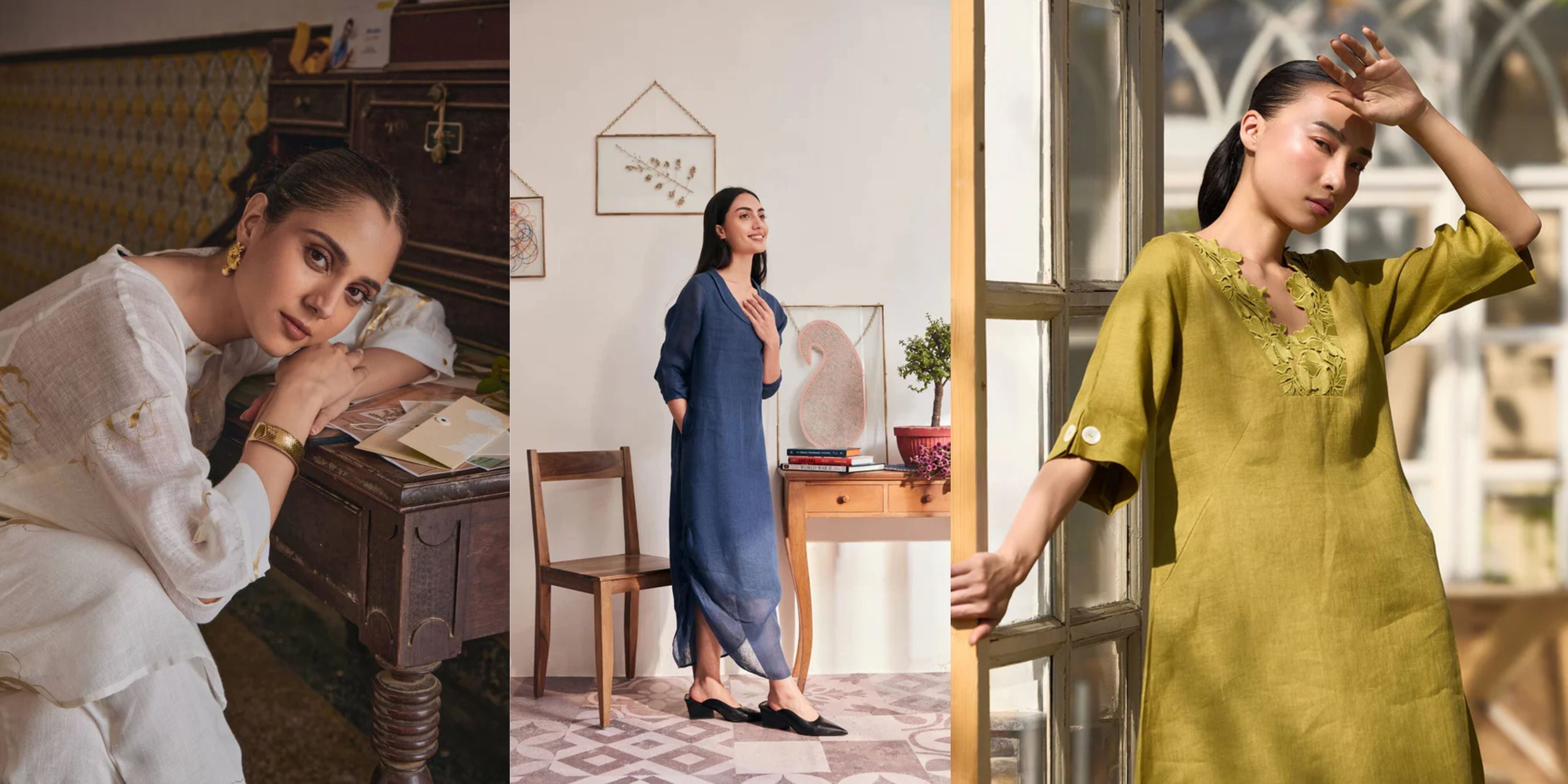
Most people buy linen because it feels good. But if you have ever owned two linen kurtas, one that drapes beautifully and one that stiffens and creases into something unwearable by noon, you will know that not all linen is the same.
The difference is almost always in the weave. Understanding linen types takes less than five minutes and saves you from choices you will regret every time you open your wardrobe. Here is what you actually need to know.
Why the Weave Determines Everything
Linen is made from flax fibre, one of the oldest cultivated plants on earth. How that fibre is woven into fabric determines its weight, drape, absorbency, and durability.
The same raw material, structured differently, gives you a crisp festive tablecloth or a soft everyday kurta. Before you choose a garment, understand the cloth. There are four principal linen weave types. Each one behaves differently on the body.
Damask Linen: The Ceremonial Weave
Damask is woven on a Jacquard loom, making it the most structurally complex linen. The pattern, usually floral or geometric, is not printed or embroidered. It is built directly into the weave itself, showing on both sides as a contrast between a matte ground and a lustrous motif.
It comes in two grades:
- Single damask, one set of warp and weft threads. Lighter, more porous.
- Double damask, two sets of finer yarns. Denser, sharper, more formal.
Damask has been the defining fabric of formal European ceremony since the 17th century. For everyday linen kurta wear, it is too structured and heavy. But for a special-occasion piece or a festive co-ord, a damask-weave kurta carries an elegance that nothing else quite replicates. It whispers occasion without announcing it.
Plain-Woven Linen: The Everyday Essential
Plain-woven linen is the most widely used and most durable linen type. Each weft thread alternates over and under each warp thread in the simplest possible structure. The result is a smooth, firm, hard-wearing cloth that holds its shape wash after wash.
For everyday linen kurtas, the kind you reach for without thinking on a Tuesday morning, plain-woven linen is the default. It takes colour well, presses cleanly, and ages better than it looks when new.
Cambric, a fine plain-weave variant originating from Cambrai in northern France, is lighter and almost translucent. The finest and most delicate variety of plain linen in common use. A loose-cut cambric linen kurta moves almost like silk. It is particularly well-suited to long days when you want the drape of linen without any of the weight.
Loosely-Woven Linen: The Long Day Choice
Of all linen types, loosely-woven linen is the most absorbent. The threads sit farther apart, creating a more porous structure that wicks moisture and allows airflow more efficiently than tightly woven varieties.
The most important sub-variety is huckaback, woven with alternating sections of plain weave and floating weft threads that create a slightly raised, uneven surface. It is the standard weave for pure linen towels precisely because of this quality. For garments, loosely-woven linen is the cloth that works hardest across a full Indian day.
One note: loosely-woven linen is less durable than plain-woven. It rewards gentle washing and careful storage. The trade-off for exceptional moisture management is worth understanding before you buy.

Sheeting Linen: Structure for the Tailored Look
Sheeting linen is the heaviest type, woven in a plain or twill construction with enough weight to give garments real structure and body. Historically used for bed sheets, woven wide enough to avoid seams, its density makes it equally suited to structured dresses, tailored kurtas, and layered Indo-Western pieces.
Butcher's linen is a coarser, stiffer relative historically made into workwear, now used in structured shirt-fronts and garment construction. For a kurta that holds its silhouette through a long day rather than wilting by mid-afternoon, sheeting is the more appropriate base fabric.
Linen Kurtas for Men: Matching Weave to Occasion
The linen kurta for men is no longer just festive or casual. It spans morning commutes, evening events, and every register in between. The weave you choose should match where you are going.
- Daily wear: plain-woven linen. Holds shape, easy to care for, takes kurta silhouettes cleanly.
- Long working days: loosely-woven linen. Maximum moisture management across extended hours.
- Festive or celebratory occasions: damask or sheeting linen. Structure and occasion-readiness.
- Travel: cambric or loosely-woven. Lightweight, packable, and recovers well from a bag.
Colour matters as much as weave. Earthy neutrals, undyed ecru, warm sand, slate grey work because they do not fight the texture of the fabric.
Linen Kurtas for Women: Drape, Fit, and Function
For women's linen kurtas, the relationship between weave and silhouette is particularly important. A looser, longer silhouette in cambric linen moves with the body. A structured knee-length kurta in sheeting linen holds form even without tailoring precision.
What makes a woman's linen kurta genuinely wearable across a full day:
- Cambric or loosely-woven for flowy, relaxed cuts. The kind that work with wide-leg linen trousers or palazzos.
- Plain-woven for sharper, more defined shapes. Kurta sets, co-ords, or kurtas worn as a shirt layer.
- Sheeting linen for structured dresses or heavier festive pieces that need to hold their line.
The best linen kurtas for women are not made from just any linen. They are made from the right linen for the cut.
Origin Matters: The Geography of Quality
The weave type tells you how a linen will behave. The origin tells you how well it was made to begin with.
Irish linen is the world's most tightly regulated textile designation. Yarn must be spun from 100% flax in Ireland and woven by Irish Linen Guild members. Genuine Irish linen is scarce, with only around eight producers remaining today.
European linen, certified under the Masters of Linen or European Flax marks, guarantees flax grown and processed in Western Europe. France, Belgium, and the Netherlands account for 93% of the world's high-quality long-line linen fibre. A geographical dominance built over centuries, enabled by a coastal climate that cannot be replicated elsewhere.
When a brand tells you their linen is European-certified, that is not marketing language. That is a material difference in what ends up against your skin.

How to Choose the Right Linen Garment
The right linen comes down to three questions.
- What is the occasion? Daily wear: plain-woven. Long active days: loosely-woven. Festive: damask or sheeting.
- What silhouette do you want? Flowing: cambric or loosely-woven. Structured: plain-woven or sheeting.
- How long is your day? A fabric that performs at 9 am should still be performing at 7 pm. Loosely-woven handles the longest days. Plain-woven handles everything else.
The linen that lasts in your wardrobe is the linen you chose, knowing what it was. Not what the label said. What the cloth actually is.
At Yell, we have worked with one fabric for fifteen years. We know which weights hold through a full day. We know which weaves work for Indian shoulders and Indian climates. We know because we have been paying attention since 2010. Explore the cloth at yellwithus.com.

Leave a comment
This site is protected by hCaptcha and the hCaptcha Privacy Policy and Terms of Service apply.